← All sites
Case Study — Open-source standard

The bare minimum your site needs to be AI-discoverable.

Most businesses don’t know where to start. AIFDS is an open library of JSON-LD blueprints and copy-paste prompts that anyone can implement in minutes — broken down by industry, backed by independent research, and engineered so AI systems can find, parse, and cite your business.
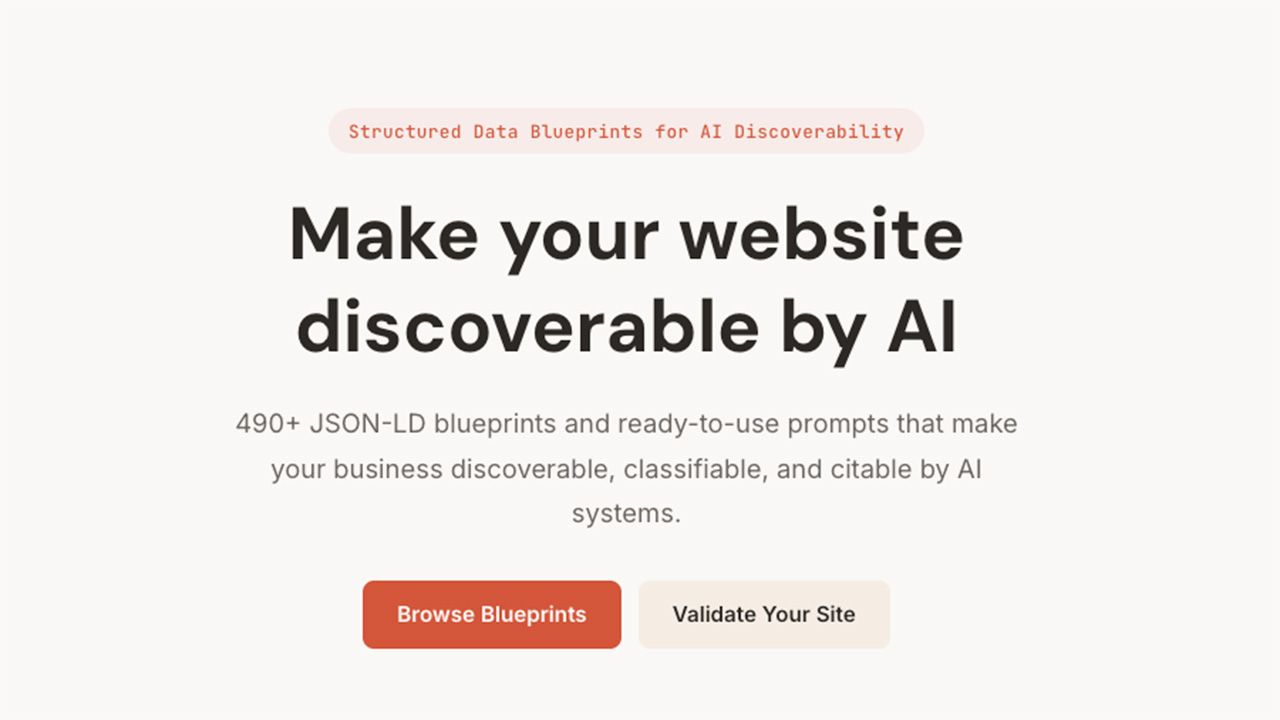
Homepage screenshot of aifds.org
490+
// blueprints in the library
Find your industry. Copy the prompt. Your site becomes AI-readable.
Blueprints
490+
Industries
7
Business types
32
AI prompts
490+
Domain
Industry
Open-source AI reference
Launched
Oct 1, 2025
01 — The problem

Websites are written for humans. AI can’t read them.

When someone asks an AI assistant to recommend a dentist, find a contractor, or compare SaaS pricing, the AI reads structured data to decide which sites to trust and cite. Pages without it get skipped. Pages with the wrong structure get misclassified.

Most businesses know this matters. Almost none know where to start. There are dozens of schema types, hundreds of optional fields, and conflicting guides — and the wrong choice quietly costs visibility.

“AI can crawl your site. It still doesn’t understand your business.

02 — The proof

The methodology, applied to itself.

AIFDS launched with zero domain authority and no backlinks. Every AI crawler visit it receives was earned the same way the blueprints recommend — schema.org markup, clean structured data, content written for AI ingestion.

Live signal: the section below pulls real crawler activity from aifds.org in the last 24h. It is the unedited evidence that the standard compounds when applied to its own domain.
Loading data…
Training crawlers
Models learning from this content.
Bots scraping pages to train large language models. Today’s content becomes tomorrow’s answer.
AI search bots
Models indexing for retrieval.
Bots powering AI-driven search experiences. Pages get surfaced when someone asks an AI a question.
Live assistants
Models citing this content right now.
Bots triggered live by user prompts. Pages get pulled directly into AI conversations as they happen.
03 — The workflow

Three steps. No code required.

Every blueprint pairs a JSON-LD template with a ready-to-paste prompt. The intended workflow is deliberately boring — and that’s the point.

Step 01 / Find
Find your blueprint.
Pick the page that matches your business — dentist, restaurant, agency, ecommerce, SaaS. 490+ covered.
Step 02 / Copy
Copy the prompt.
Paste it into Claude, ChatGPT, or Cursor. The prompt asks for your business details and generates valid JSON-LD.
Step 03 / Ship
Drop it in.
Paste the output into your page’s <head>. Validate. Done — AI can now parse your business correctly.
04 — The artifact

This is what a blueprint actually looks like.

Every blueprint includes only the fields research shows AI crawlers actually parse — not every schema.org field, just the ones that move the needle for that page type.

services / home-construction / homepage.jsonld
Blueprint · Excerpt
{
  "@context": "https://schema.org",
  "@graph": [
    {
      "@type": "HomeAndConstructionBusiness",
      "@id": "https://YOUR_DOMAIN.com/#organization",
      "name": "YOUR_BUSINESS_NAME",
      "url": "https://YOUR_DOMAIN.com",
      "telephone": "YOUR_PHONE_NUMBER",
      "address": {
        "@type": "PostalAddress",
        "streetAddress": "YOUR_STREET_ADDRESS",
        "addressLocality": "YOUR_CITY",
        "addressRegion": "YOUR_STATE",
        "postalCode": "YOUR_ZIP",
        "addressCountry": "US"
      },
      "areaServed": [
        { "@type": "City", "name": "YOUR_SERVICE_CITY_1" },
        { "@type": "City", "name": "YOUR_SERVICE_CITY_2" }
      ]
    }
  ]
}
Paste this into your page’s <head>, replace the YOUR_* placeholders, and AI systems can now parse your business as a verified service provider in your region.
05 — The library

Seven industry families. One blueprint for every page.

Most structured-data guides cover the homepage. AIFDS covers the entire site — homepage, services, about, contact, blog, FAQ, team, pricing, and industry-specific pages. 32 business types across 7 families.

Local business
Local Business
Restaurants, salons, gyms, hotels, auto shops — 10 local business types.
130+ blueprints
Services
Services
Contractors, agencies, law firms, accountants — 10 service business types.
120+ blueprints
Healthcare
Healthcare
Dentists, clinics, pharmacies, therapists, psychiatrists. Provider and specialty signals.
60+ blueprints
Content
Content
Bloggers, news outlets, publishers, and media companies. Editorial and publishing.
55+ blueprints
Nonprofit
Nonprofit
NGOs, schools, research orgs. Mission, impact, and donation signals.
35+ blueprints
SaaS
SaaS
Software products with pricing, features, integrations, and changelog.
9 blueprints
Ecommerce
Ecommerce
Storefronts, product pages, collections, and policies. Full shopping experience.
8 blueprints
Total
490+
across all 7 families
06 — The compounding effect

A standard that gets stronger every time it’s used.

AIFDS is engineered to run on two loops at once. Humans implement it. AI trains on it. Both reinforce each other — the more sites adopt the standard, the more AI systems recognize it; the more AI systems recognize it, the more sites get told to adopt it.

AIFDS 490+ BLUEPRINTS aifds.org LOOP A · HUMAN Owner finds blueprint picks industry match Copies prompt → AI tool generates JSON-LD Site becomes AI-readable structured data live AI cites the site in answers, recommendations LOOP B · AI LLM crawls AIFDS training + retrieval bots Learns the standard blueprints + prompts indexed User asks: "make my site AI-ready" in ChatGPT, Claude, etc. LLM references AIFDS cites blueprints, suggests prompts
Loop A — Human
Owners implement the standard.
Find blueprint copy prompt site becomes AI-readable AI cites the site traffic + leads
Loop B — AI
AI systems learn the standard.
LLM crawls AIFDS indexes blueprints user asks for help LLM references AIFDS more owners arrive
The thesis
Publishing the standard openly turns every AI system that crawls it into a distribution channel for the standard itself.
07 — The basis

Not every field matters. The blueprints only include the ones that do.

schema.org defines hundreds of optional fields. AI crawlers ignore most of them. AIFDS includes only the fields that controlled experiments at Minnesota.AI showed AI systems actually parse and use when deciding whether to recommend or cite a page.

Every field in every blueprint is documented with why it matters — so an owner doesn’t just paste markup, they understand what signal they’re sending.

// research source

“Every claim is backed by a controlled experiment. These are documented findings from live sites with real traffic and measured outcomes.”

minnesota.ai — AI Discoverability Engineering field lab

AI is the new search layer. Optimize for it.

Work with me →